2C01
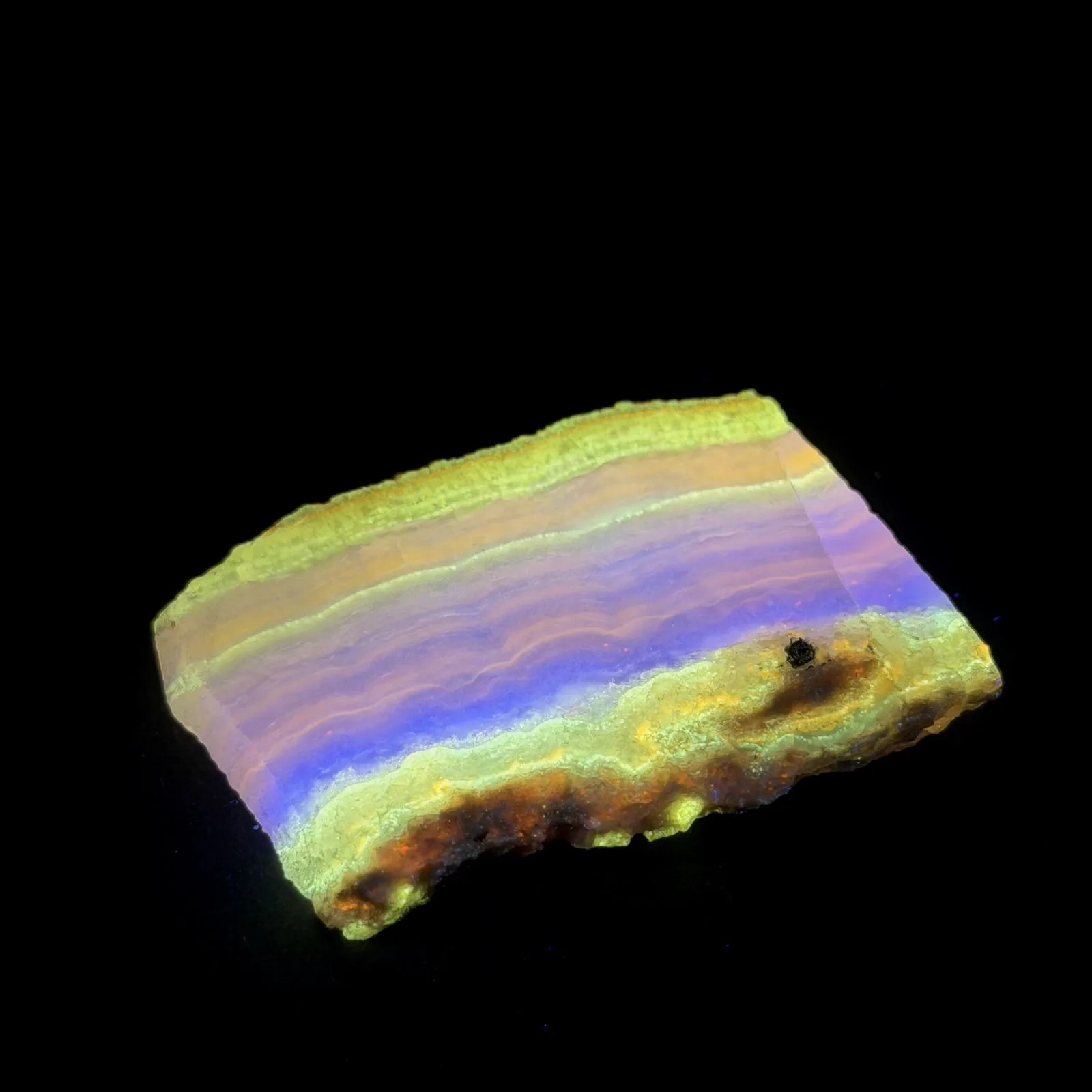
Hokkaidoite slice 2C01
A polished slice of hokkaidoite-bearing opal from Hokkaido. Under UV light the growth bands glow in layers of yellow-green, violet and orange.
- Size
- 5.4 × 4.1 × 0.5 cm
- Weight
- 18 g
- Origin
- Hokkaido, Japan
Kitsune Mineral · Hokkaidoite
Hokkaidoite — the organic mineral from Hokkaido, Japan, that glows vivid yellow-green under ultraviolet light. Curated, documented and photographed under both lights.
Selected pieces
Every piece is photographed under ultraviolet light and in daylight. Switch the lighting at the top of the page.
The Flagship
Of all hokkaidoite specimens recorded to date, this is the largest known — the centrepiece of the Kitsune Mineral collection. It is shown only to museums, collecting institutions and established collectors, by appointment.
Collection & exhibition inquiriesProvenance
The cover reference photograph of hokkaidoite on mindat.org, the world's largest mineral database, shows a specimen from the Kitsune Mineral collection. Our key specimens are laboratory-tested and registered with a mindat minID.
Our specimens are among the reference images of hokkaidoite on mindat.org, credited to 狸狸礦坑 kitsune_crystal.
Every single specimen priced from NT$100,000 comes with a certificate from the MDmineralresearch (敏德礦研) laboratory, registered with a mindat minID and verifiable online by its number.
Any specimen purchased from Kitsune Mineral can be sent to the laboratory for testing and certification, at the laboratory's official fee.
Laboratory fee: approx. US$100–150
Worldwide
Our specimens are shown at the major international mineral shows, and we deliver to collectors in every part of the world.
Where our specimens are shown
StockistsHong Kong · K11 Art Mall Midnight Handmade
Insured, individually packed shipping to collectors in any country. Overseas payment by PayPal or bank transfer.
The mineral
Hokkaidoite (北海道石) is one of the newest and most unusual minerals ever described: a natural crystal of an aromatic hydrocarbon, made only of carbon and hydrogen, preserved inside opal from ancient hot springs.
Hokkaidoite is natural benzo[ghi]perylene (C₂₂H₁₂), a polycyclic aromatic hydrocarbon. It is the first mineral of its kind described from Japan, and is regarded as a natural precursor of the organic compound coronene.
At Shikaribetsu it occurs as inclusions in opal deposited by ancient hot springs in volcanic terrain; at Aibetsu it is found in cavities of quartz veins. Heat from the Earth transformed organic matter, which was then captured and crystallised.
In daylight the crystals are pale yellow, tiny plates or dendrites that are barely visible. Under UV light they blaze yellow to yellow-green — beautifully contrasting with the orange fluorescence of the host opal.
Approved by the International Mineralogical Association (IMA2022-104) in January 2023 and presented at the Japan Geoscience Union Meeting 2023. Named after Hokkaido, where it was found.
Sources: Science Japan (JST), 11 July 2023; mindat.org; Journal of Mineralogical and Petrological Sciences.
Partnerships
We welcome mineral companies, galleries and museums from every country to work with us on hokkaidoite.
Discuss a partnershipRegular supply for mineral dealers and shops, with documented origin for every piece.
Represent Kitsune Mineral hokkaidoite in your country or region.
Specimens for exhibitions, education and scientific study.
About Kitsune Mineral
Kitsune Mineral (狸狸礦坑) is a Taiwan-based mineral specialist focused on fluorescent species, with hokkaidoite at the heart of our collection.
Our specimens appear at the major international mineral shows. We deliver to collectors worldwide, and work with mineral companies, galleries and museums as partners.
Each specimen is labelled with its origin and catalogue number.
What you see is what you receive — every piece is shown under both lights.
Specimens are individually packed for safe international shipping.
We reply in English, 中文 and more.
FAQ
Hokkaidoite (北海道石) is a new mineral approved by the International Mineralogical Association in January 2023 (IMA2022-104). It is a natural crystal of benzo[ghi]perylene (C₂₂H₁₂), a polycyclic aromatic hydrocarbon made only of carbon and hydrogen. It was the first mineral of this type discovered in Japan and is named after Hokkaido, where it was found.
Benzo[ghi]perylene molecules absorb ultraviolet light and re-emit it as visible light, so hokkaidoite fluoresces a strong yellow to yellow-green under long-wave UV. It is usually found inside opal, which itself fluoresces orange, creating a striking multi-colour glow. Hokkaidoite also glows under ordinary handheld UV torches.
The type locality is the Shikaribetsu area in Shikaoi, Tokachi, Hokkaido, where hokkaidoite occurs as inclusions in opal deposited by ancient hot springs. The co-type locality is Aibetsu in Kamikawa, Hokkaido, where it occurs in cavities of quartz veins.
In ordinary light the crystals are pale yellow, tiny tabular plates or dendritic aggregates that are often hard to see inside the host opal. Its beauty is revealed under ultraviolet light, which is why every Kitsune Mineral specimen is photographed in both daylight and UV light.
The largest known hokkaidoite specimen in the world is held in the Kitsune Mineral collection. It is a single mass of hot-spring opal from Hokkaido with hokkaidoite throughout, and is shown only to museums, collecting institutions and established collectors, by appointment.
Yes. The cover reference photograph of hokkaidoite on mindat.org, the world's largest mineral database, shows a specimen from the Kitsune Mineral collection, credited to 狸狸礦坑 kitsune_crystal. Our key specimens are registered with a mindat minID.
Yes. Every single hokkaidoite specimen priced from NT$100,000 (about US$3,100) comes with a laboratory certificate from MDmineralresearch (敏德礦研), registered with a mindat minID and verifiable online by its certificate number. For any other specimen bought from Kitsune Mineral, we can arrange laboratory testing and certification at the laboratory's official fee.
Kitsune Mineral (狸狸礦坑), a Taiwan-based fluorescent mineral specialist, offers documented hokkaidoite specimens to collectors worldwide. Collector pieces are listed with prices and can be bought online; signature pieces are offered by private inquiry. Each specimen has a catalogue number and daylight + UV photographs. Contact us by email, Instagram (@kitsune_mineral) or WhatsApp, or visit our booth at international mineral shows.
In Hong Kong, Kitsune Mineral hokkaidoite slices, specimens and collaborative hokkaidoite jewellery are on permanent display and for sale at Midnight Handmade, shop 312, 3/F, K11 Art Mall, Tsim Sha Tsui. In Taiwan, we exhibit in person at one or two mineral shows every month in Taipei, Hsinchu, Taichung and Kaohsiung. Internationally, we exhibit in person at the China Nanjing International Mineral, Gemstone & Fossil Expo and, from October 2026, at The Munich Show (Mineralientage München). During the Tucson Gem & Mineral Show our specimens are available through a partner dealer — contact us and we will point you to them. Show dates are announced on Instagram @kitsune_mineral.
Yes. Kitsune Mineral delivers worldwide with individual protective packing. Overseas customers can pay by PayPal or bank transfer. Please send an inquiry with the specimen number and your country for a shipping quote.
Yes. Kitsune Mineral welcomes mineral companies, galleries and museums from every country for wholesale supply, regional distribution and exhibition partnerships. Choose “Wholesale / distribution partnership” in the inquiry form or email us directly.
Keep it in a closed display case away from dust, heat and long exposure to direct sunlight, as with most fluorescent mineral specimens. Handle it gently, as the host opal can be brittle. Use UV lamps for viewing rather than leaving them on continuously.
Contact
For specimen availability, private viewings, wholesale and distribution partnerships or show appointments, send us a message. We usually reply within 24–48 hours.
Worldwide delivery · PayPal or bank transfer for overseas orders.